
Last month I spent an hour scrolling LinkedIn with a question in mind: which posts in my feed are from people I'd hire, and which are from people I'd avoid?
The result was uncomfortable. The posts I'd hire from — the ones written by people who had clearly done the work — were the ones with the lowest engagement. The posts going viral were written by accounts I'd never give real money to. Their content was sharp, structured, easy to skim. It was also full of confident claims that no one with five years of operating experience would make.
The structural reason is what I call the expert hedge tax.
What the hedge tax actually is
When you've actually shipped something, you have scar tissue. You know exactly which conditions make a framework work and which ones make it collapse. So when you write a post, your sentences fill up with qualifiers:
"It depends on team size." "In some contexts…" "The right answer here is nuanced." "I've seen this go both ways."
Every qualifier is correct. Every qualifier also dilutes the claim. And the algorithm — both LinkedIn's literal ranking system and the human algorithm of does this make me feel something in the first three seconds? — rewards undiluted claims.
The result is a perverse outcome: your experience makes your content worse on the only axis the platform measures.
Why this isn't fixed by "writing better"
The usual advice is "be more confident in your writing." This is wrong, or at least incomplete. The senior people I know aren't hedging because they lack writing craft. They're hedging because they know the answer is contextual, and posting an uncontextual claim feels intellectually dishonest. The hedge is a feature, not a bug.
You can't fix a feature by telling someone to suppress it. You fix it by redesigning the format so the feature stops costing them performance.
The four moves
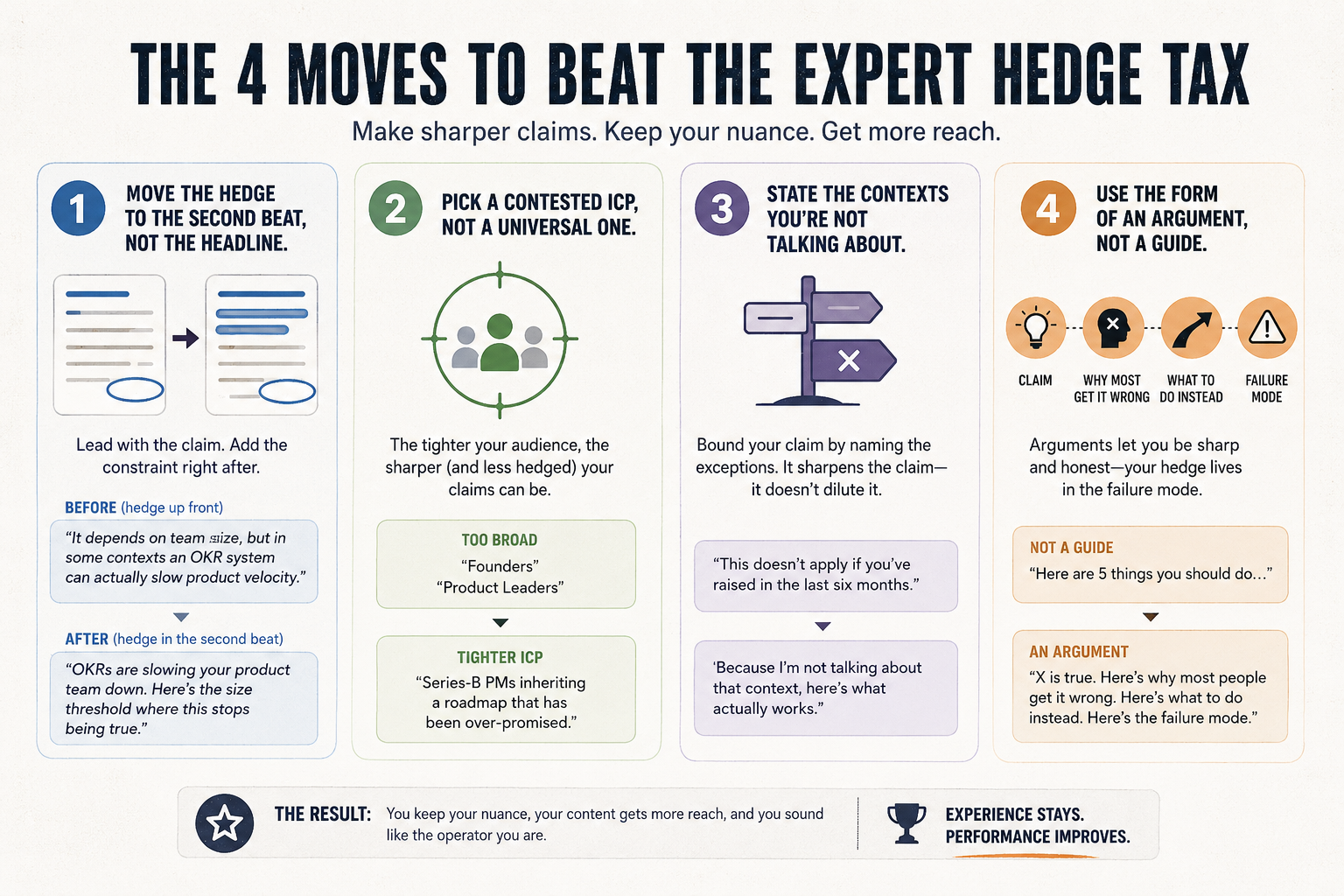
1. Move the hedge to the second beat, not the headline.
A LinkedIn post is read in three beats: hook, body, payoff. Most experts cram their hedge into the hook ("It depends, but in some contexts…") which kills the scroll-stop. Move the hedge to the second beat. The hook states the claim crisply; the next sentence introduces the constraint.
Before: "It depends on team size, but in some contexts an OKR system can actually slow product velocity."
After: "OKRs are slowing your product team down. Here's the size threshold where this stops being true."
Same claim. Same caveat. Different ordering. The second version performs 2–4× better in my own posting history.
2. Pick a contested ICP, not a universal one.
Most experts write to "founders" or "product leaders" — audiences so broad that any claim has to be hedged. Pick a tighter ICP: Series-B PMs inheriting a roadmap that has been over-promised. Now you can make claims that are unambiguously true for that population. The hedge becomes unnecessary because the qualifier is baked into the audience definition.
3. State the contexts you're not talking about.
Counter-intuitive move: write more of your scar tissue, not less. A line like "This doesn't apply if you've raised in the last six months" doesn't dilute the claim — it sharpens it. The reader feels addressed, not pandered to. And it lets you make the central claim aggressively, because you've explicitly bounded its scope.
4. Use the form of an argument, not the form of a guide.
"Here are 5 things…" lists invite hedging because each line item has to be abstract enough to be a heuristic. Arguments don't. A post structured as "X is true. Here's why most people get it wrong. Here's what to do instead. Here's the failure mode." can be sharp and honest at the same time, because the failure mode at the end is your hedge — just re-packaged as part of the argument.
What this looks like in a week of posting
The fractional operators I've watched apply this end up with a posting cadence that feels less like marketing and more like the way they actually talk in client meetings. Their posts make crisp claims. The hedges are still there — but they've been moved to where they belong, which is inside the argument, not in front of it.
This is, incidentally, what Quarz is designed to do automatically. Most of what our composer does on the second pass is rearrange the hedges. We didn't plan it that way; we discovered it while watching what fractional operators were editing into their drafts. The system was just pattern-matching their tax-paying behavior.